
Cooking is one of the few daily tasks that almost everyone improves with music. It is repetitive enough to leave attention free, physical enough to benefit from rhythm, and long enough that silence starts to feel like work. What is less obvious is that the music you choose may not just accompany the meal — it can quietly colour how the food itself is experienced.
Sound really does reach the plate
There is a small, serious research field devoted to this, usually called sonic seasoning. In a 2020 study published in Foods, Reinoso-Carvalho, Gunn, ter Horst and Spence ran a tasting experiment with 1,611 participants, pairing the same chocolate with different music. When the accompanying music carried a positive emotional tone, participants rated the chocolate as having a softer texture and reported greater willingness to buy it than when the music was emotionally negative. The chocolate never changed. The soundtrack did.
The authors are careful about what this means: these are shifts in perception and preference, not transformations of the food. But for anyone cooking at home, the practical lesson is cheerfully simple — the music is part of the meal.

Match the music to the stage, not the dish
Most people choose music by cuisine, which is fun but misses the point. Cooking has phases, and they want different things. The chopping and prep stage benefits from something with forward motion; the simmering, tasting, adjusting stage wants something that does not nag. Bossa nova is the classic solution because it manages both — it moves without hurrying. Alma Carioca is our fullest Brazilian selection, and Bahia Bar works well when there is a drink involved.
For weeknights: keep it light
On an ordinary Tuesday the goal is not atmosphere but momentum — getting dinner made without the evening feeling like a chore. Lounge and light grooves do this unobtrusively. Feel Good Lounge keeps things moving, and our Improving Mood collection is a reliable place to start when the day has been long. The broader case for using music this way is covered in Music to Lift Your Mood.
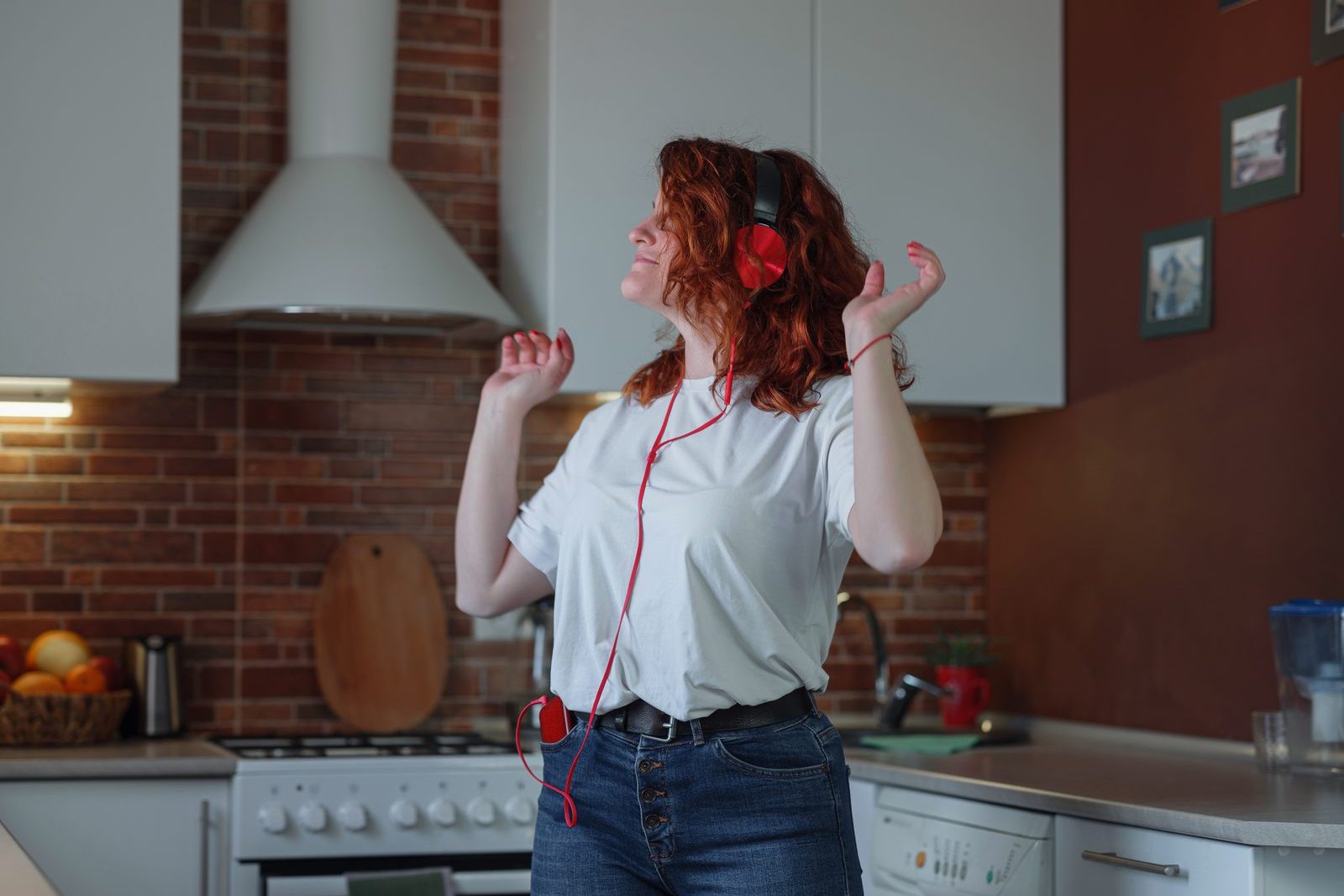
For slow cooking: let classical take over
Something braising for two hours is a different proposition. Here the kitchen becomes a room you inhabit rather than pass through, and classical music earns its place. Chamber repertoire and solo instruments are ideal because they hold a mood without demanding the foreground. Try Classical Afternoon for something gentle and daylit, or Classic Flute Collection if you want air and lightness rather than weight. For a long autumn Sunday, Classic Sensations will carry the whole afternoon.
A note on volume and lyrics
Two small adjustments make a disproportionate difference. First, volume: kitchens are hard-surfaced and loud, and the instinct is to turn music up to compete with extractor fans and running water. It is usually better to choose something with a fuller, warmer texture than to raise the level. Second, lyrics: if you are following an unfamiliar recipe and reading as you go, instrumental music tends to interfere less with the words on the page.
And when the cooking is done and people sit down, it is worth changing the music rather than letting the prep playlist run on. The shift from making to eating is one of the nicest transitions of the day, and a change in sound is the easiest way to mark it — Blue Gin is a good place to land.
Sources
- Foods — Reinoso-Carvalho, Gunn, ter Horst & Spence, Blending Emotions and Cross-Modality in Sonic Seasoning (2020). 1,611 participants.
- Frontiers in Psychology — Schäfer, Sedlmeier, Städtler & Huron, The psychological functions of music listening (2013).
Image credit: Envato Elements.
Created with the help of artificial intelligence.
